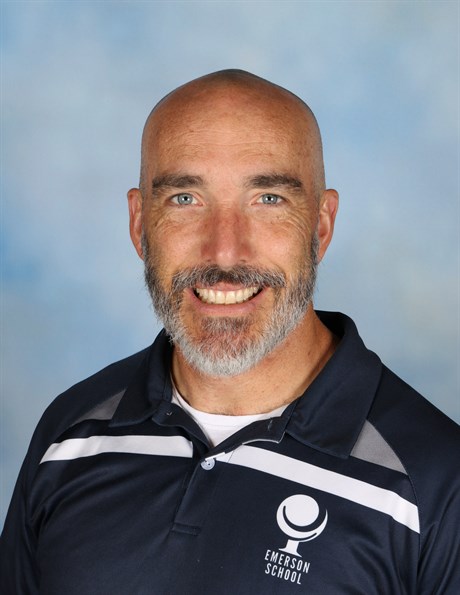
Lincoln Bowen’s music career has spanned many facets, from performing with heavy metal bands including Mortification, Day of Atonement and The Eternal, to touring and performing across the United States, Europe, South Africa, New Zealand and South America, to teaching music in mainstream and now specialist school settings.
He joined Emerson School in 2008, and says his role as the Head of Music is one of the most rewarding experiences of his career. “When I first considered working at Emerson and observed classes and spoke to students and staff, I realised everything I love about teaching music—the noise, the action and the energy—is amplified here,” he says. “Emerson really is a happening place.”
The music program at Emerson spans all year levels from Junior to Senior School.
“The environment here is supportive, not just at primary age, but right through the years for all students. The scaffolding that assists learning in mainstream primary schools tends to drop away once kids reach high school. But at Emerson, the focus remains on what we can do to support each student in their journey all the way to graduation and beyond.”
Even post-Emerson, there is still a sense of connection. Lincoln references a past-students group, one of whom is now 47, who return to the school every Monday evening to rehearse and jam. They often play at gigs, including at school events, and their continued involvement with the school encapsulates the joy and connection they found at Emerson through music.
“My passion for teaching music is given an even stronger focus at Emerson,” Lincoln says. “It is around the strengths of the students, the development of relationships, the sense of personal achievement, and the opportunity for social connection.”
He says students can learn social responsibility as well as connection, a vital skill that will assist them in their lives beyond school. “Being part of a band or contributing as part of a group, and the experience of learning and performing with others, helps them understand what it is to be an active and responsible member of society,” he says.
“Music fosters a sense of belonging and a stronger sense of identity and self-esteem.”
Lincoln completed a Master of Specialist Inclusive Education at Deakin University in Melbourne, with his area of study including drumming in an educational environment and the effect on someone with autism.
“When someone is playing music—drums, for example—in time with someone else, a particular area of the brain lights up,” he says. “This is the same area that lights up when someone is given positive gratification such as being handed money. That’s a powerful tool for teaching and learning.”
Part of Lincoln’s approach to teaching is about helping his students look at how to unpack and analyse music, including what it means and what feelings it evokes.
“There is always emotion attached to the sound of certain instruments. It’s well known that pitch can affect you physically, but the added layer of being part of a group, and performing in sync with others, is particularly transformative for our students.”
Music offers Emerson students recognition of their expertise in a particular area. Lincoln notes that music can reach those who may not have the chance to shine academically and gives them other opportunities to achieve and feel good about themselves.
“My music philosophy is, if it sounds good, it is good.”
As former student Sebastian N stated in the 2025 school yearbook: “My favourite memory of Emerson School is my chat with Mr. Bowen, that despite me not wanting to perform because I thought I wasn’t good enough, he convinced me that it is not what I want, but instead what the band needs. It gave me a new way to look at things.”
[interviewed March 2026]